Book Appointment Now


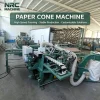
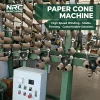
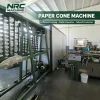
Paper Cone Machine for Textile Yarn — Fully Automatic Three-Unit Production Line
Fully automatic paper cone machine for textile yarn cones: winding unit, CNC drying room and CNC finishing unit. 40-60 pcs/min, Taida PLC, 54 KW. CE-certified builder since 2005.
Paper Cone Machine for Textile Yarn — Fully Automatic Three-Unit Production Line
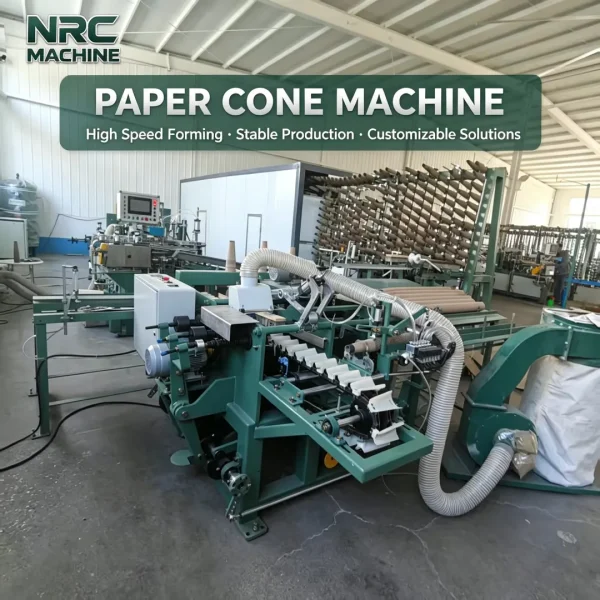
NRC Automatic Paper Cone Making Machine is a fully automatic paper cone production line for the textile industry. One paper cone machine installation combines a paper cone winding unit, a CNC drying room and a paper cone finishing unit under a single PLC control network, producing 40–60 yarn cones per minute with 2–3 operators per shift.
What Is a Paper Cone Machine?
A paper cone machine is the production equipment that converts plain paper rolls into the tapered paper cones and tubes that spinning mills wind yarn onto. Instead of making a straight core, a cone machine forms a tube on a mandrel with a fixed taper, so the cone seats squarely on the spindle of a winding, twisting or doubling machine and the yarn unwinds smoothly at high speed.
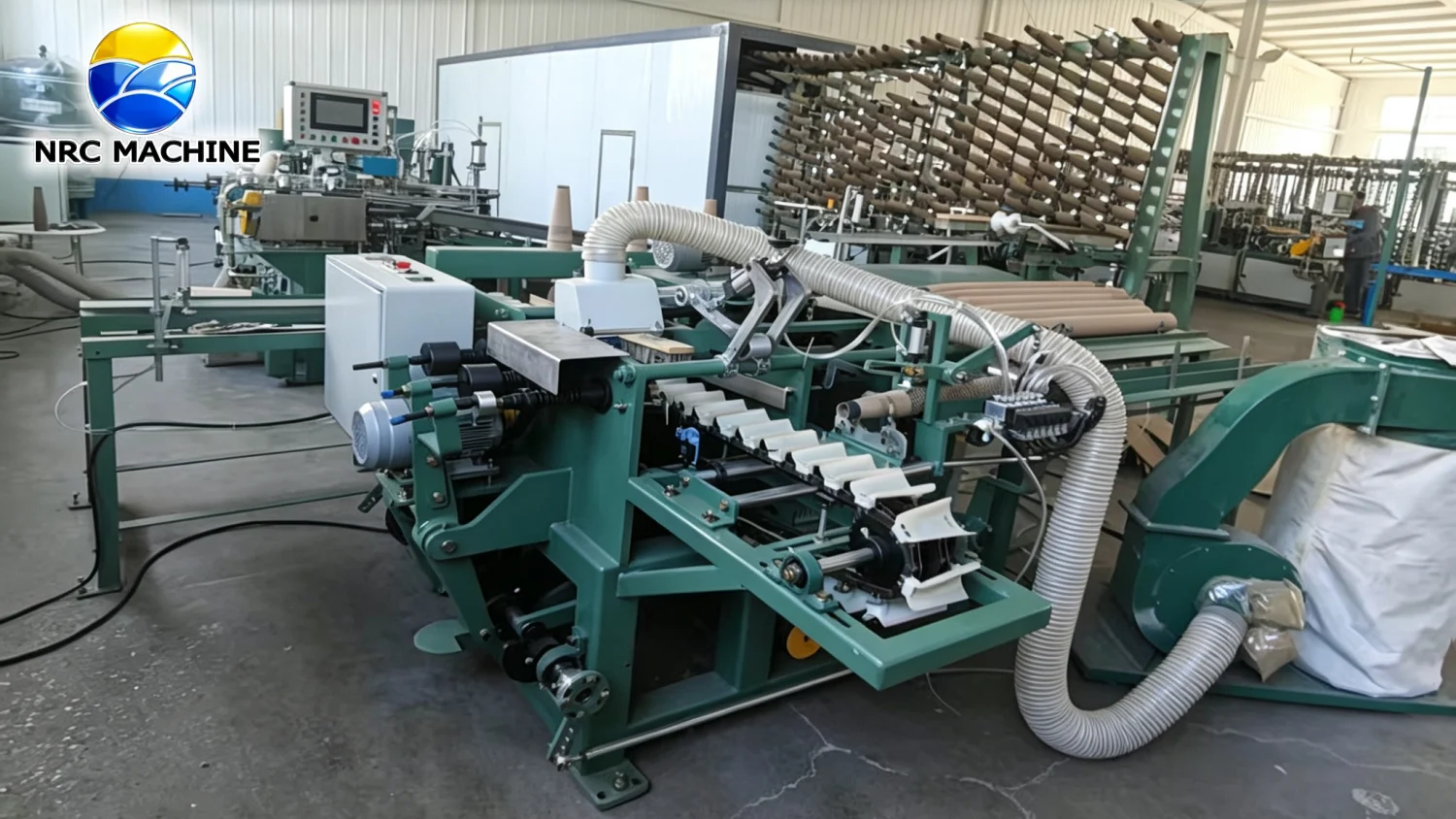
Because a cone is a wound, glued and dried paper structure rather than a moulded one, three separate operations decide quality: accurate spiral winding with even adhesive, controlled drying that removes moisture without deforming the taper, and precision finishing of the mouth, the grip head and the V-shaped port. That is why an industrial paper cone machine is supplied as a three-part line instead of a single station — the winding unit, the drying room and the finishing unit described below.
Yarn Cones the Line Produces
The line supplies paper cones and paper tubes for textile yarn winding, including cones used for DTY and POY yarn packages. All parameters in this section come from the machine specification sheet published by NRC MACHINE.
| Table 1. Product range of the paper cone machine | |
| Attribute | Specification |
| Cone angle — standard | 5°57′ or 4°20′ |
| Cone angle — producible range | 3°, 4°, 5° and 9° textile tube specifications |
| Custom sizes | Supported; cone dimensions can be customised to the customer’s yarn specification |
| Applicable paper grammage | 80 – 450 gsm |
| Adhesive | White glue, applied on both sides of the paper (double-sided gluing) |
| Line output | 40 – 60 pieces per minute |
| Typical end use | Yarn winding cones and textile paper tubes for spinning, twisting and doubling departments |
Gluing method and why it matters. This paper cone machine adopts the “cut the paper first, then glue” process. Waste offcuts therefore carry no adhesive, and the flexible polyurethane spreading rollers meter the glue evenly instead of flooding it. Combined with double-sided gluing, the same design removes the layering that appears in cheaper cones and measurably raises the hardness and roundness of the finished tube, which is what keeps a cone from ovalising under high tension during yarn take-up.
Line Layout: Three Units, One Control Network
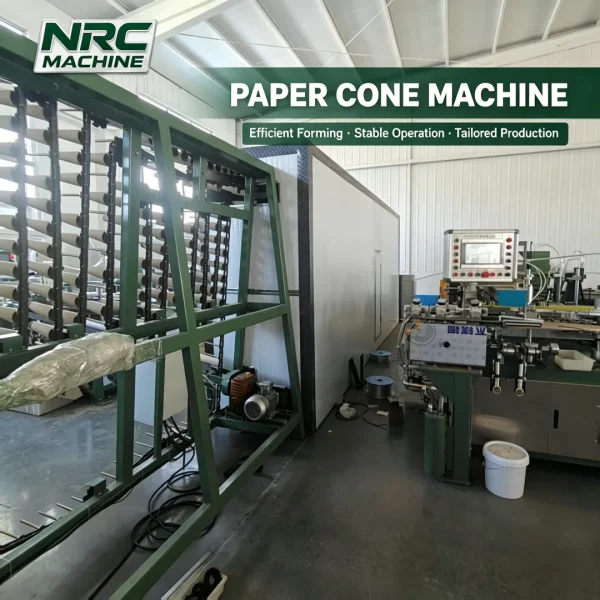
The complete paper cone making machine line is built from three mechanically independent but synchronised units. The dryer and the finishing machine automatically follow the speed set on the winding unit, so the line runs as one continuous process.
Process flow
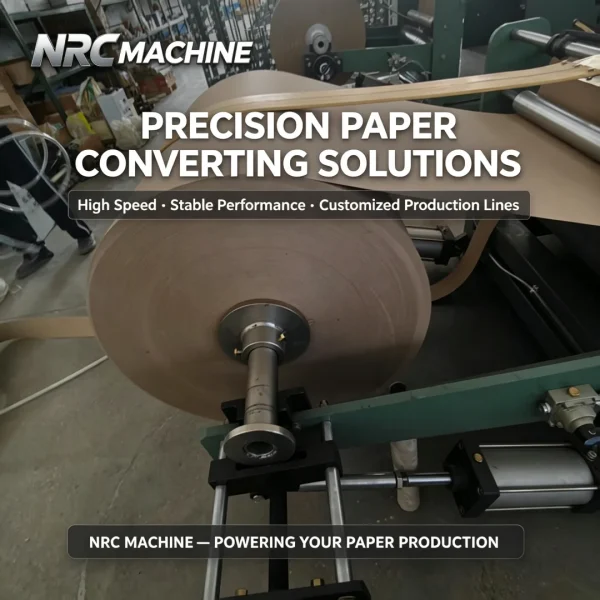
- Raw paper roll loading— paper of 80–450 gsm is mounted on the winding unit.
- Inside and outside printing— markings applied to both faces of the paper.
- Inside and outside edge grinding— both edges bevelled so the glued seam is clean.
- Paper cutting and gluing— cut-then-glue with pneumatic diaphragm glue pump, double-sided, even distribution.
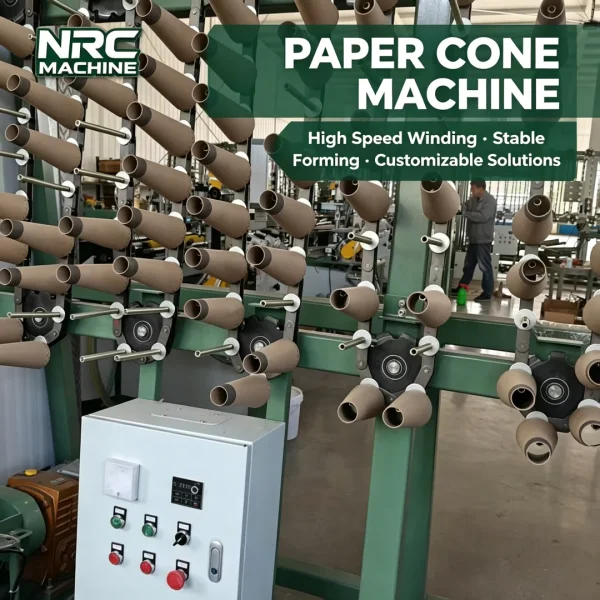
- Cone winding— paper spiralled onto the mandrel at the set taper; automatic tube withdrawing.
- CNC drying— wet cones conveyed through the drying room; dryer speed follows winding speed.
- CNC finishing— automatic tube feeding, oiling, grip head, wire pressing, wool drawing, V-shaped port punching, counting and string inserting.
- Packaging— counted cones with inserting string, ready for the winding department.
| Table 2. Unit-by-unit summary of the paper cone machine line | |||
| Unit | Function | Speed | Operators |
| Part A — Paper cone winding unit | Printing, edge grinding, cutting, gluing, winding, automatic tube withdrawal | 35–60 pcs/min (maximum 60) | 1–2 workers |
| Part B — CNC drying room | Heat-dries the wet cones to structural rigidity | 30–60 cones/min, auto-synchronised | None dedicated |
| Part C — CNC finishing machine | Feeding, oiling, grip head, wire pressing, wool drawing, V-port punching, counting, string inserting | 30–60 cones/min | Shared with the line crew |
| Complete line | Raw paper to packaged yarn cones | 40–60 pcs/min | 2–3 persons per shift |
Whole-Line Technical Parameters
| Table 3. Automatic paper cone production line — main parameters | |
| Parameter | Value |
| Machine type | Fully automatic paper cone production line for the textile industry |
| Control system | Delta PLC control (listed as Taiwan Taida in the unit component tables) |
| Line composition | Paper cone winding unit + drying room + paper cone finishing unit |
| Production speed | 40 – 60 pieces per minute |
| Cone size | 5°57′ or 4°20′; customisation supported |
| Applicable paper | 80 – 450 gsm |
| Applicable glue | White glue |
| Compressed air | 1.2 m³/min at 0.8 MPa |
| Total installed power | 54 KW / 380 V / 50 Hz / 3 phases |
| Operator requirement | 2 – 3 persons per shift |
| Total weight | About 10 tons |
| Required working space | 14,000 mm × 8,000 mm × 5,000 mm (L × W × H) |
| Voltage options | 380 V at 50 Hz or 60 Hz, per the component specification |
Figures above are quoted from the manufacturer’s published specification sheet. Where a value depends on the configuration you select, the final figure is confirmed on the proforma invoice.
Part A — Paper Cone Winding Machine
What the winding unit does
The paper cone winding machine is the cutting and cone-forming section of the line. It performs the printing and the cone winding work in one pass, and applies glue to both sides of the paper. Raw paper leaves this unit as a wound, glued, still-damp semi-finished cone that is passed straight to the dryer. The maximum speed of the unit is up to 60 pcs per minute, operated by one or two persons.
| Table 4. Paper cone winding unit — overall specification | |
| Parameter | Value |
| Overall dimensions | 5,500 × 1,600 × 1,400 mm (5.5 L × 1.6 W × 1.4 H m) |
| Weight | About 3.5 tons |
| Operators | 1 – 2 workers |
| Electricity | 380 V, 3 phases, 50 Hz |
| Speed | 35 – 60 pcs / minute (maximum up to 60 pcs/min) |
| Power | 13 KW |
| Tube specifications produced | 3°, 4°, 5°, 9° — various textile tubes |
| Table 5. Winding unit — structure, drive and component brands | |
| Item | Specification / brand |
| PLC | Taiwan Taida |
| Servo controller | Taiwan Taida |
| Servo motor | Taiwan Taida |
| Man-machine interface (HMI) | Taiwan Taida |
| Pneumatic components | Taiwan Yadeke |
| Electric light / photoelectric parts | Japan Omron |
| Low-voltage electrical parts | Domestic Xinling; Zhejiang Zhengtai |
| Sliding table | Qingdao Tengqi (Taiwan silver rod guide) |
| Precision reducer | Niushidate |
| Triangle belt | Zhejiang Sanlishi |
| Casting parts | Grey iron 250# |
| Large shaft | Straight hard optical axis |
| General motors | RongCheng Huali |
| Gear motor | Zhongda Jidian |
| Wire rope / cable | Jiangsu Liyang Shangshang cable |
| Glue pump | Pneumatic diaphragm pump |
| Dust extraction | Vacuum cleaner / dust collector |
| Front platform material | 45 mm steel plate |
| Rear platform material | 25 mm steel plate |
| Frame material | 50 × 100 national-standard torque tube; 100 × 100 national-standard square tube |
| Production rate | 30 – 60 cones / minute |
| Voltage | 380 V, 50 Hz / 60 Hz |
Energy saving: installed power cut from 18 KW to 12.6 KW
On the energy side, the installed power of the mechanical units of this generation of paper cone machine has been reduced from 18 kilowatts to 12.6 kilowatts. For a mill running the line for two or three shifts a day, that reduction is one of the more visible items in the monthly electricity cost of the cone shop.
Noise reduction and dust control
The high-power fans used on the earlier mechanical equipment have been dropped. Professional dust absorption equipment is fitted instead, which handles both the paper dust and the noise load and improves the working environment for the technicians standing at the machine all shift.
Cutting and step accuracy
With the newer cutting tools working together with the modified equipment transmission, the paper running step of the production line can be shortened by 5%–10%. A shorter step means less paper per cone at the same taper, which is where the material saving comes from.
Gluing quality and cone hardness
The production cost model uses the cut-paper-then-glue technique, so waste material carries no glue, and glue is spread evenly by flexible polyurethane rollers. This saves glue and lowers tool wear. Because the paper tube is glued on both faces, the layering defect common in low-cost cones is eliminated, and the hardness and roundness of the tube improve visibly — the two properties that decide whether a cone survives high-tension yarn winding.
Part B — CNC Drying Room
How the drying room works
The function of the drying room is to dry the wet cones coming from the winding machine by heat. No special person is required to work on it: the speed of the dryer automatically changes according to the speed of the paper cone machine winding unit, so the drying time per cone stays correct whatever rate the operator selects.
| Table 6. CNC drying room — technical parameters | |
| Parameter | Value |
| Overall dimensions | 7,600 × 1,200 × 3,200 mm (can also be customised to the customer’s space) |
| Weight | About 3 tons |
| Machine drive | 1.7 KW |
| Electric power | 32.4 KW (electric furnace wire) + 3 KW (fan) |
| Heat source options | Electric (standard); steam, coal, natural gas or liquefied gas on customer demand |
| Speed | 30 – 60 cones / minute, synchronised with the winding unit |
| Chain | 50.8 double pitch, one-inch weight chain |
| Control system | Co-cabinet control with the main engine |
| Large frame | Channel steel, no. 8 national standard |
| Main frame | 160 × 80 national-standard torque tube |
| Heat preservation | GB fire-grade glass wool board |
| Gear motor | Cuhk motor |
Choosing a heat source for your factory
Built on many years of production experience, the drying equipment was developed by a team of specialists and the heat source can be installed in various forms: electric drying, coal drying, steam drying, natural gas drying and liquefied gas drying. The practical selection rule is simple — use whichever energy is cheapest and most reliable at your site.
| Table 7. Drying room heat source options | |
| Heat source | Best suited to |
| Electric (furnace wire) | Factories with stable power and no boiler house; simplest installation |
| Steam | Textile mills that already run a steam plant for other processes |
| Coal / wood | Locations where solid fuel is the lowest-cost energy and permitted locally |
| Natural gas (LNG) | Sites with piped gas; even temperature control |
| Liquefied gas (LPG) | Regions supplied by bottled or bulk LPG |
The chamber is insulated with GB fire-grade glass wool board, which holds the temperature steady and keeps the shell safe to work beside. Control is shared with the main engine in one co-cabinet, so the operator sets the line in one place.
Part C — CNC Paper Cone Finishing Machine
The finishing operations
For the post-processing stage of the paper cone machine line, the semi-finished paper tube leaving the drying box is processed through automatic tube feeding, oiling, grip head, wire pressing, wool drawing, V-shaped port punching, and counting with string inserting. Company engineers combined years of production experience with advanced international CNC technology, so cone quality, efficiency, stability and environmental cleanliness are all addressed at this station.
| Table 8. CNC finishing machine — technical parameters | |
| Parameter | Value |
| Overall dimensions | 2,500 × 1,600 × 1,400 mm |
| Weight | About 3 tons |
| Total power | 9.3 KW |
| Speed | 30 – 60 cones / minute |
| Platform material | 20 mm steel plate |
| Frame material | GB standard 60 × 80 torque tube |
| Table 9. Finishing machine — component specification | |
| Item | Brand / specification |
| PLC | Taiwan Taida |
| Man-machine interface | Taiwan Taida |
| Cylinders | Taiwan Yadeke |
| General motors | RongCheng Huali |
| Gear motor | Zhongda Jidian |
| Photoelectric parts | Japan Omron |
| Low-voltage electrical parts | Domestic Xinling |
| Triangle belt | Domestic Xinling |
| General electric parts | Zhejiang Zhengtai |
| Large shaft | Straight hard optical axis |
| Bearings | Haerbin; Fushan FK |
| Wire rope / cable | Jiangsu Liyang Shangshang cable |
| Dust extraction | Vacuum cleaner / dust collector |
Why the finishing unit decides cone quality
A cone can be wound correctly and still fail on the spindle if the grip head is off, the wire press is loose, or the V-shaped port is punched out of position. Automating these operations on a CNC station removes the variation that hand finishing introduces, and the counting and string-inserting steps are performed in the same cycle, so the cones arrive at the winding department already counted and packaged.
Utilities, Footprint and Manpower
Before ordering a paper cone machine, confirm these four items with your plant engineer. The values below are the ones the line is designed around.
| Table 10. Installation requirements checklist | |
| Requirement | Design value |
| Working space | 14,000 mm (L) × 8,000 mm (W) × 5,000 mm (H) |
| Electrical supply | 54 KW total, 380 V, 3 phases, 50 Hz (60 Hz available) |
| Compressed air | 1.2 m³/min at 0.8 MPa |
| Manpower | 2 – 3 persons per shift for the complete line |
| Floor loading / total weight | About 10 tons of equipment — confirm the floor capacity for your building |
| Heat source (if not electric) | Steam, coal/wood, LNG or LPG supply as selected for the drying room |
Why Buyers Specify This Paper Cone Machine
- One control network across three units.Delta PLC on the line, Taida PLC, servo drive, servo motor and HMI on the winding and finishing stations, with the dryer controlled from a co-cabinet with the main engine — one place to set and monitor the whole process.
- Speed matched to real yarn demand.40–60 pcs/min at the line level, up to 60 pcs/min on the winder, with dryer speed tracking the winder automatically.
- Lower running cost.Installed power of the mechanical units reduced from 18 KW to 12.6 KW; paper running step shortened by 5%–10%; cut-then-glue with polyurethane rollers reduces glue waste and tool wear.
- Cone quality that survives winding tension.Double-sided gluing solves tube layering and improves hardness and roundness.
- Named component brands.Pneumatics from Yadeke, photoelectric parts from Omron, bearings from Haerbin and Fushan FK, frames in national-standard torque and square tube, castings in grey iron 250# — listed in Tables 5 and 9 rather than described in general terms.
- Customisation is standard, not optional.Cone angles beyond 5°57′ and 4°20′, dryer dimensions to suit your building, and the heat source you can actually buy.
- Operator-friendly environment.Professional dust absorption replaces the old high-power fans, cutting both dust and noise at the machine position.
About the Manufacturer — NRC MACHINE
Machine credibility is a purchasing decision, so here is the company record as published by NRC MACHINE (Qingdao New Richuan Precision Machine Co., Ltd):
| Table 11. Manufacturer profile | |
| Item | Detail |
| Company | Qingdao New Richuan Precision Machine Co., Ltd (abbreviation: NRC MACHINE) |
| Founded | 2005 |
| Experience in paper tube and paper processing machinery | More than 18 years |
| Export reach | 80+ countries |
| Cooperative companies | 700+ |
| Certificates | CE certificate on machines; ISO and SGS certificates listed by the company |
| Main products | Paper tube making machine, paper slitting rewinding machine, toilet paper making machine, paper edge protector making machine, notebook making machine, A4 paper reams making machine and related paper processing machinery |
| Facilities | Shandong branch — East of Zhangjialiugou Village, Economic Development Zone, Fangzi District, Weifang City, Shandong Province (120 km from Qingdao Airport); Hebei branch — Zhangzhuang village, Xiongxian, Baoding City, Hebei Province |
| Service | Professional sales team with after-sale service |
| Web | https://nrcmachine.com |
| Response promise | Email enquiries answered within 6 hours |
Every technical figure in this page is taken from the machine specification sheet and the company profile published by NRC MACHINE. Where a value depends on the configuration selected — dryer size, heat source, voltage, cone dimensions — the confirmed figure appears on the quotation and the proforma invoice, not on this page.
FAQs — Paper Cone Machine
1. What does a paper cone machine do in a textile mill?
It turns raw paper rolls into the tapered cones and tubes that yarn is wound onto. The line prints and grinds the paper edges, applies white glue on both sides, cuts and winds the paper into a cone, dries the wet cones, then feeds, oils, presses, punches the V-port and counts the finished cones. See the process flow in Table 2.
2. How many cones can one machine produce?
The line runs at 40–60 pieces per minute. At that stated speed this works out to roughly 2,400–3,600 cones per hour, or about 19,000–29,000 cones across an eight-hour shift. Real output depends on cone size, paper grammage and drying conditions.
3. Which cone angles are supported?
5°57′ and 4°20′ are the standard angles, and the winding unit is specified for 3°, 4°, 5° and 9° textile tube specifications. Other dimensions can be customised for your yarn.
4. What paper grammage can the machine handle?
From 80 gsm to 450 gsm. Grammage is normally chosen together with the required yarn load, because double-sided gluing plus paper weight is what sets cone hardness.
5. What glue is used, and how is it metered?
Standard white glue, delivered by a pneumatic diaphragm glue pump and spread with flexible polyurethane rollers. The cut-then-glue sequence means offcut waste carries no adhesive, so glue consumption and tool wear both fall.
6. How much space, power and compressed air does the line need?
Allow 14,000 × 8,000 × 5,000 mm of working space. Total installed power is 54 KW at 380 V, 50 Hz, three phases, and compressed air demand is 1.2 m³/min at 0.8 MPa. The line weighs about 10 tons, so check floor loading before installation.
7. How many workers operate the line?
Two to three persons per shift for the whole line. The winding unit alone needs 1–2 workers; the CNC drying room needs no dedicated operator because its speed follows the winding machine automatically.
8. Can the drying room run on steam, gas or coal instead of electricity?
Yes. Electric furnace wire (32.4 KW plus a 3 KW fan) is the standard build, and the dryer can be configured for steam, coal, wood, natural gas (LNG) or liquefied gas (LPG). Choose by Table 7 according to the cheapest reliable energy at your site.
9. Can the winding machine, dryer or finisher be bought separately?
Each unit has its own dimensions, drive and control specification in Tables 4–9, so single-unit or partial-line supply can be discussed with our engineers. State the units you need in your enquiry and we will quote that configuration.
10. Is the paper cone machine CE certified?
NRC MACHINE states that its machines carry CE certification, and ISO and SGS certificates are listed on the company profile. Ask for the certificate set that applies to the exact configuration you order.
11. What is the price of this paper cone machine?
Price is configuration-dependent — cone angle and size, dryer dimensions, heat source, voltage and finishing specification all change the build. Send the yarn cone sample or drawing you need to produce and we will quote the matching line.
Request a Quote
Talk to an NRC engineer about your paper cone machine.
Send your cone dimensions, paper grammage and daily output target. Reply within 6 hours.
Manufacturer: NRC MACHINE — Qingdao New Richuan Precision Machine Co., Ltd
Phone / WhatsApp / WeChat: +86 15254213289
Email: james@nrcmachine.com
Website: https://nrcpapermachine.com
| Weight | 8000 kg |
|---|---|
| Dimensions | 1100 × 220 × 200 cm |
Reviews
There are no reviews yet.